
NOTE: This website is frequently updated. Last update March 2025
Article written in 2010
THE DAVID GILMOUR / PINK FLOYD BIG MUFF PI DISTORTION SUSTAINERS - In the long list of great rock and roll guitarists associated with the Electro-Harmonix Big Muff Pi, Pink Floyd guitarist David Gilmour is one of the most well known and accomplished users. A 1970s V2 "Ram's Head" model seems to be the version he preferred to use the most, both in Pink Floyd, and for his first solo album. A Big Muff was prominently used on Pink Floyd's The Wall double album, including the legendary Comfortably Numb solos, as well as the massive and aggressive Big Muff tones heard on the 1977 In the Flesh tour for the Animals album. David's long time backline tech, Phil Taylor, said he introduced David to the Big Muff in 1974, although I do not believe David started using one regularly until around 1975 or '76. After that, the Big Muff appeared on many notable Pink Floyd / David Gilmour works:
1976-77 - Animals album and In The Flesh tour
1978 - David Gilmour's first solo record, David Gilmour
1979-81 - The Wall studio recordings and live performances
1983 - The Final Cut studio recordings
1987-1988 - the Momentary Lapse of Reason studio recordings and 1987-88 tour
1988 Delicate Sound of Thunder live album
1994 - The Division Bell tour
1994 - Pulse live album
2001-02 - the Meltdown concerts
2006 - the On an Island tour
2015/2016 - the Rattle that Lock tour
Note - for a very thorough and comprehensive guide to all of the gear David Gilmour used in these periods, look no further than Gilmourish.Com. Also check out the wonderful Tone From Heaven website for a comprehensive look at David's gear from the Division Bell-Pulse era, On an Island, and David's custom Pete Cornish effects rigs.
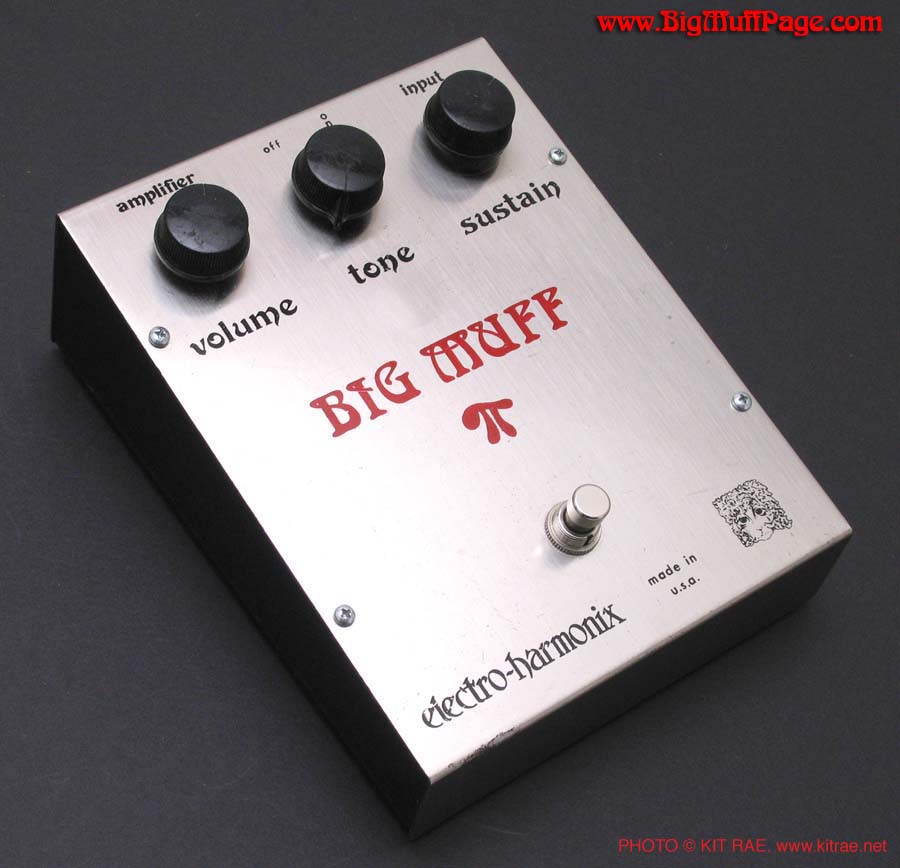
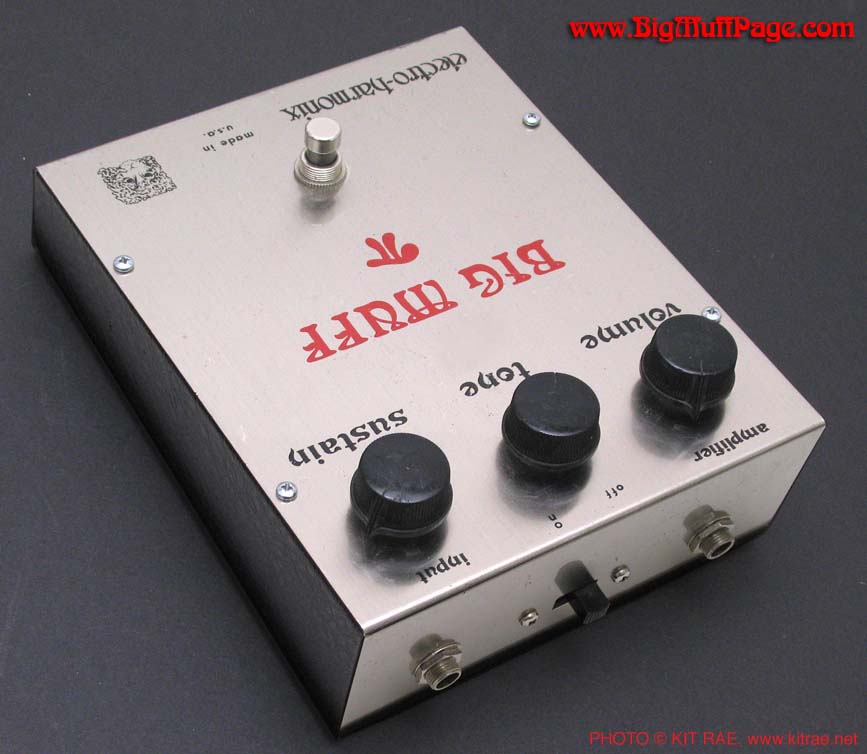
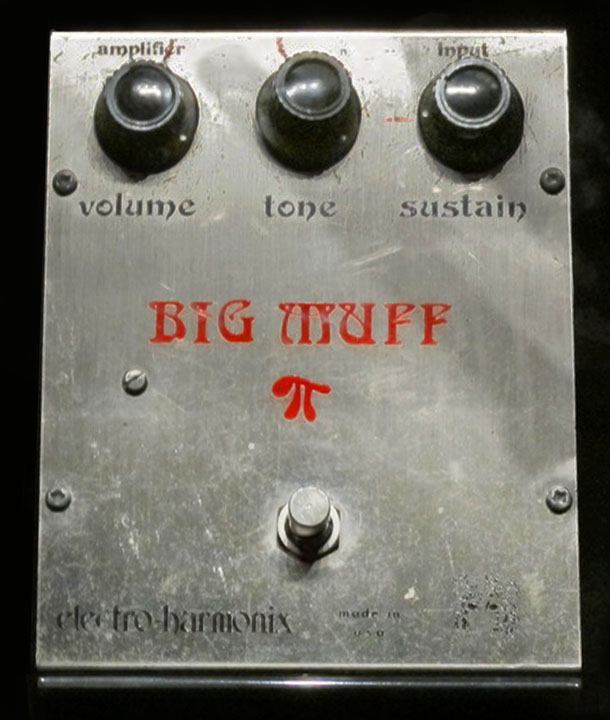
Shown above - A stock Electro-Harmonix Big Muff Pi from 1974 (left), and one of David Gilmour's 1970s Big Muffs (right)
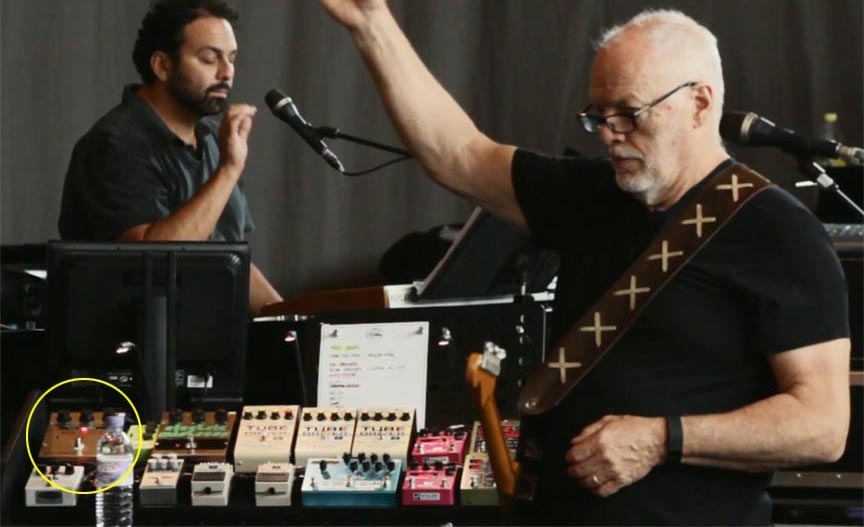
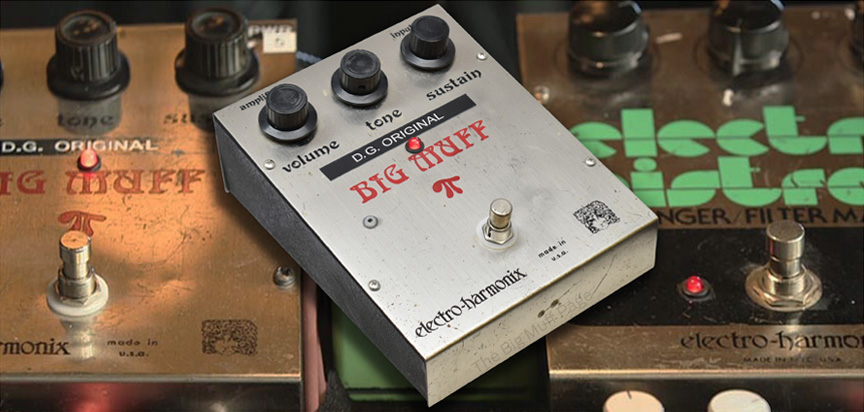
Shown above - David Gilmour's 2015 rehearsal pedal board with his first Big Muff from 1974, with DG ORIGINAL label on top. The red LED is an after-market mod.
THE "DG ORIGINAL" BIG MUFF - According to Phil Taylor, that very first Big Muff Pi he gave to David "has often been preferred for most things" over others David owned. This original unit was likely David's main recording fuzz box from 1976-1983. It is often seen with the label DG ORIGINAL on top. In 1974 or 1975 Phil purchased another 1974 Big Muff for David to use on tour. It did not sound exactly the same as the original and Phil became aware that the component values of Big Muffs were not consistent from unit to unit. That is a well known fact to Big Muff collectors today, and one reason why they became so collectible, but was a frustrating problem for a musician needing a backup Big Muff. Trying to find two that sounded identical was a challenge, and thus Phil had the second one modified to sound the same as the first.
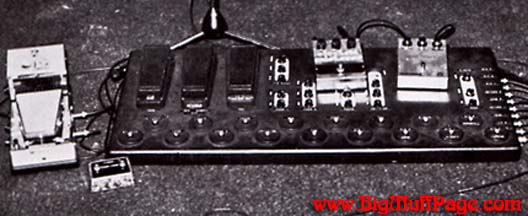
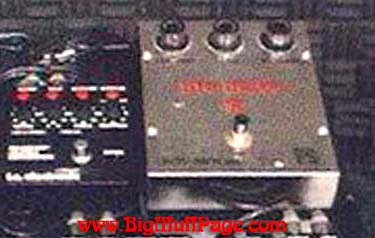
THE PETE CORNISH BIG MUFF MODIFICATIONS - In 1976 effects rig legend Pete Cornish created a new pedal board for David to use on tour, shown above in a photo from the Animals song book that was taken during London rehearsals for the In the Flesh tour in late 1976. Pete was asked to modify the 1974 DG ORIGINAL Big Muff David wanted to take on tour to get it up to modern standards. He replaced the potentiometers and foot switch with higher quality parts and and added a buffer to make it compatible with the routing system he designed and built into the pedal board. This Big Muff is the one shown in the photo above. If you look closely, you can the extra rivet on top that holds the buffer in place inside the pedal, and a black foot switch, rather than the standard silver one. That DG ORIGINAL was used on Pink Floyd's 1977 tour and the 1987-88 tour. It can be heard all over the Pink Floyd live album The Delicate Sound of Thunder. It did not have the DG ORIGINAl label on it back then, but it has the same knobs, buffer rivet, and after-market black foot switch as it did later in 2006 when the DG ORIGINAL label was added to the top.
I introduced David to the Electro-Harmonix Big Muff Pi in 1974. He liked it, and he has continued to use one ever since. David has tried many of the different incarnations and models over the years, but his original has often been preferred for most things. Finding another that sounds the same is not easy, I have even placed six in a row that externally appeared to be identical to his original, and they all sounded different. Often, when you look inside, some components and values are different... - Phil Taylor. Guitar Player, January 2009
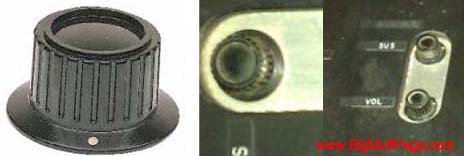
You will note that the DG ORIGINAL Big Muff features unique skirted knobs, similar to the type of knobs used on the old Dallas Arbiter Fuzz Face pedals. EHX used at least 10 different knob types on the V2 Big Muffs, but never this type of knob. Pete replaced the stock potentiometers with higher quality pots, but these new pots had round shafts. The original E-H knobs fit D-shaped shafts, so they could not be used. Pete was using Fuzz Face knobs with round shaft holes and grub screws in his effects rigs at the time, so David's Big Muff was fitted with those. These same knobs can be seen in Brian May's Queen gear, and various other pedal boards Pete Cornish built for other guitarists at the time.
I asked Pete Cornish if the DG ORIGINAL Big Muff he modified in 1976, and used on the 1977 tour, was the same one that David used for the 1987-88 tour, and he confirmed it was. However, he has made the same modifications to several Electro-Harmonix Big Muffs for David Gilmour. These are two that I know of:
• David's original 1974 Big Muff, first seen on Pink Floyd's 1977 and 1987-1988 tours, at the Bray studio rehearsals for his 2006 On and Island tour, and used for the 2015/2016 Rattle That Lock tour - identified by the Fuzz Face style knobs, rivet one top to hold the buffer inside, black footswitch, and DG ORIGINAL label on top. When it was seen in 2015 a red LED was added, and the black footswitch was replaced with a silver one.
• The Big Muff displayed at Pink Floyd's Their Mortal Remains exhibition in 2017, identified by the Fuzz Face style knobs, rivet one top to hold the buffer inside, standard footswitch, and no LED.
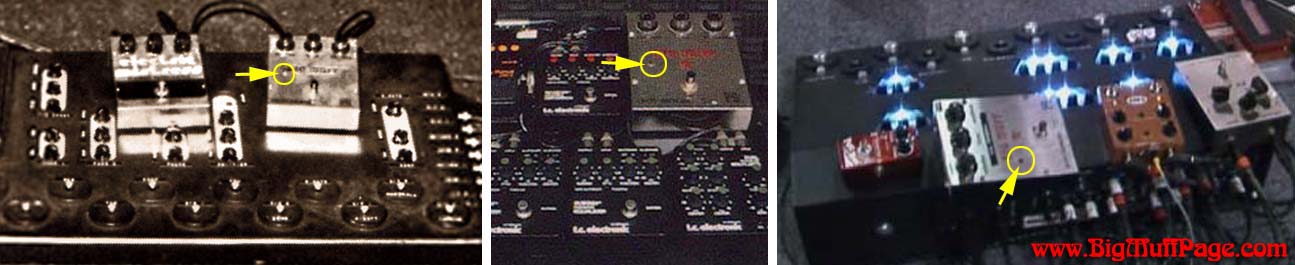
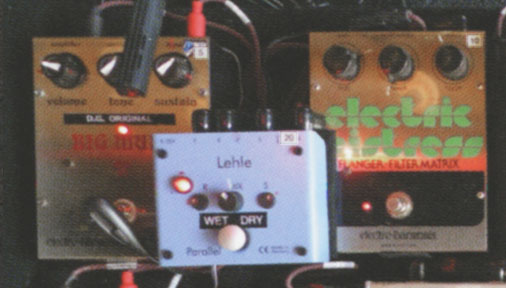
Shown above (left) David Gilmour's DG ORIGINAL Big Muff and Electric Mistress from the 1977 In The Flesh/Animals
tour board. (middle) The same Big Muff used for his 1987-88 rig. (right) The DG ORIGINAL (with label added)
on top of his tour pedal board seen at the Bray Studios rehearsal in 2006, along with a Triangle Big Muff. Note
that the Big Muffs in all of these photos have the same Fuzz Face knobs and same after-market black footswitch.
The rivets on top (circled) are to mount the pcb of the Pete Cornish buffer built into the pedals.
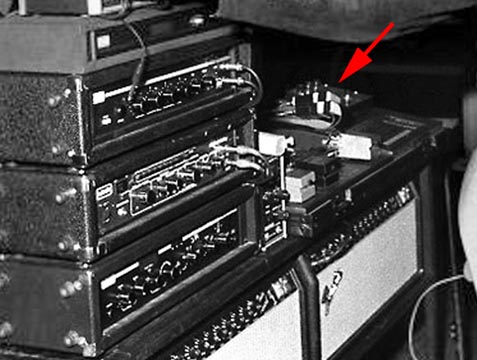
Shown above - A Ram's Head Big Muff on David Gilmour's 1984 pedal board.
 ...
... ...
...
Shown above, left to right - The Dallas Arbiter Fuzz Face style, skirted grub screw knobs seen on the Pete Cornish modified Big Muffs are replacements added by Pete when he replaced the pots in Gilmour's Big Muffs. They were also used on Pete's custom pedal boards from the late 1970s. The middle photo is another Pete Cornish pedal board from this time with the same knobs (thanks to Rafal and Pete for verifying the knobs)
Shown above - David Gilmour's 2015 tour pedal board with his original 1974 Big Muff, labeled DG ORIGINAL
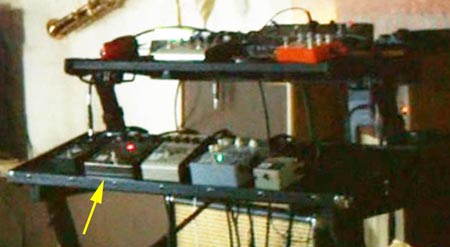
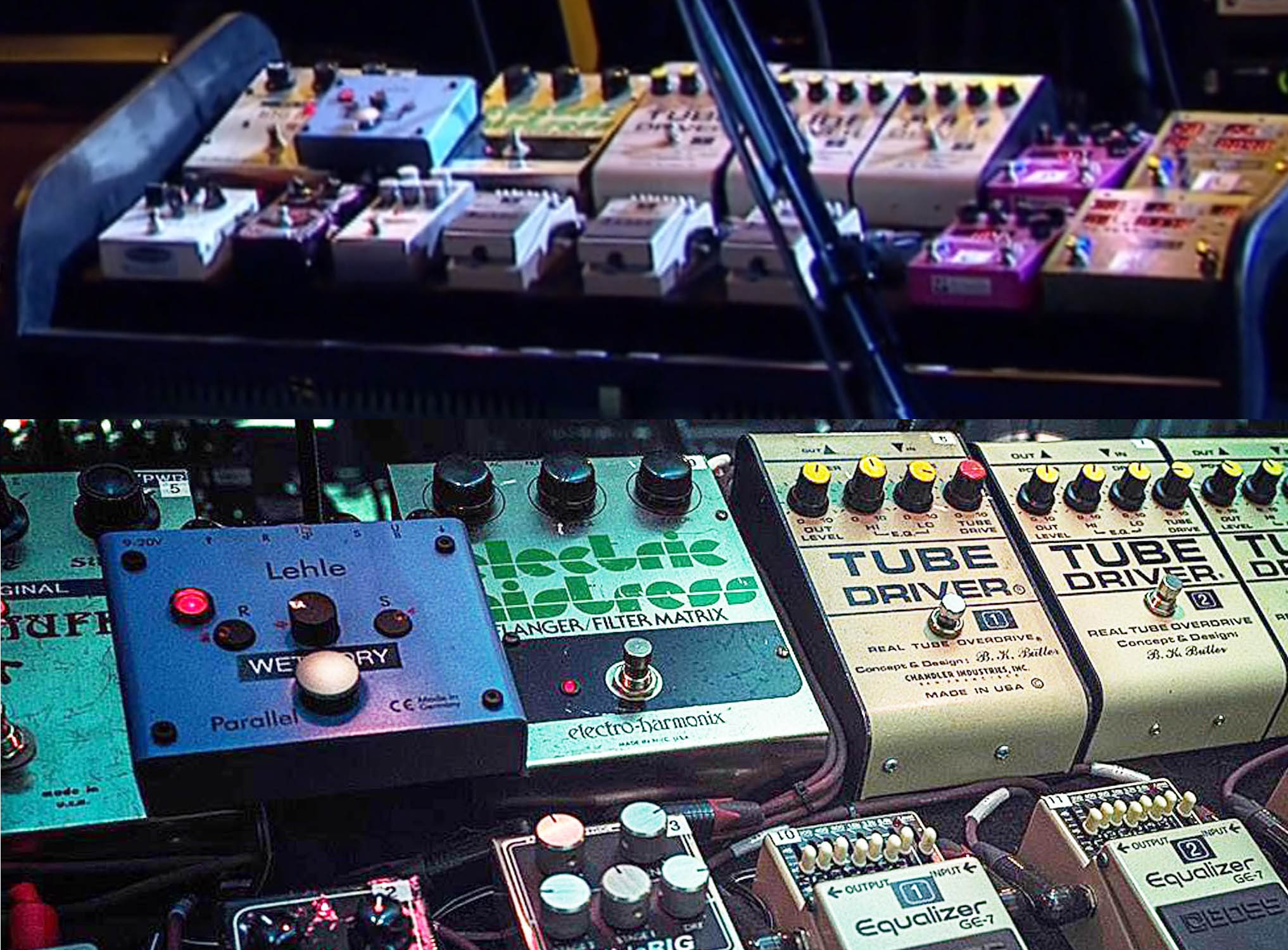

Shown above (left) A Ram's Head Big Muff in Gilmour's Farmhouse Studio in Sussex in 2015 and David's original Ram's Head (with DG ORIGINAL label)
(right) A Big Muff seen in Gilmour's Hove studio in 2017
Shown above (left) David Gilmour's 2016 tour pedal board with his original 1974 Big Muff, with red LED added and DG ORIGINAL label.
(right) Another Cornish modified Big Muff displayed at Pink Floyd's Their Mortal Remains exhibition in 2017.




GILMOUR'S TRIANGLE BIG MUFFS - David owns several V1 "Triangle" Big Muffs, and used a Triangle Big Muff for his 2006 On An Island tour. It was mounted on top of his pedalboard and used for the funky middle section of Echoes, heard on the Remember That Night and Live in Gdnask concert videos. This first version of the Big Muff got its nickname from the triangular layout of the control knobs. It is unknown if David has ever recorded in the studio with a one, but a Triangle with an LED added was seen on a testing pedal board in 2011, and a different one in his Medina studio in 2017.

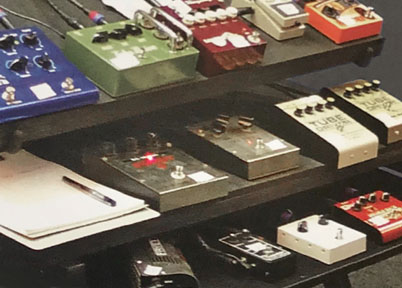
Shown above - David Gilmour's 2006 tour pedal board with Triangle Big Muff on top, and a testing pedal board in 2011
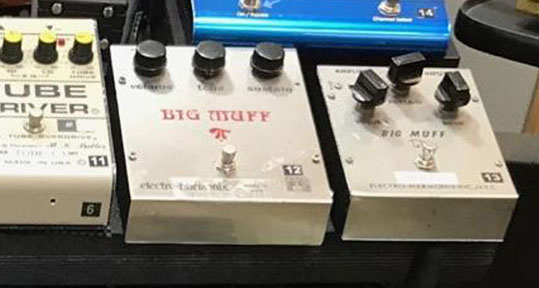
Shown above - A Ram's Head Big Muff and Triangle Big Muff from David's Medina studio in 2017
David Gilmour Big Muff Sound Clips - Below is a selection of various Gilmour solos using the Big Muff Pi, in this order: Dogs solo live from Oakland California, Dogs solo from Animals studio album (both 1977), Mother solo, Young Lust solo, and Comfortably Numb solo (all from The Wall 1977), Final Cut solo and Fletcher Memorial Home solo (from The Final Cut in 1983), On an Island second solo (this may actually be a Tube Driver) and the intro to Sorrow (from A Momentary Lapse of Reason in 1987).
 David Gilmour Big Muff Pi Solo Selections 3.9MB
Below is a selection of audio and videos showing various ways to use a Big Muff for David Gilmour tones. David rarely used a Big Muff alone when he used them for guitar solos. He was a master and combining it with other effect to create his own unique guitar tones.
Below are a few demo videos of the Ram's Head reissue. All of the guitar was done with the reissue or gold anniversary Ram's Head. The first video is a demonstration of how well the reissue blends with an overdrive and the second demonstrates stacking with other effects.
THE BIG MUFF CIRCUIT - Phil Taylor purchased several other V1 and V2 Big Muffs for David Gilmour throughout the late 1970s. Each had varying versions of the circuit inside, resulting in them sounding slightly different from each other. Even though the topology of the circuit pathways (those silver lines you see on the back of the circuit boards) were exactly the same on all Big Muffs, it is the electrical values and type of components used that defines the sound. Why were there so many different variations of the circuit, you may ask? Well, Electro-Harmonix bought circuit components like capacitors and resistors in bulk to get the best prices. Often the availability of components with a specific electrical value from one bulk purchase to the next were different, so the componenst with the clostest value to the one neede were bought instead. To accommodate this, they would simply revise the schematic to work with components EHX had on hand. For example, if 470pF capacitors used in the gain stages were not currently available, but 430pF were, those would be used as a substitute for the next production run.
This resulted in numerous versions of the circuit - over a dozen variants for the V1 Triangle Big Muff and nearly twenty for the V2 Ram's Head. Hundreds to thousands of each circuit variant were made. Some sounded only marginally different from the others, but several of these sounded significantly unique. Most of those 1970s Big Muffs sounded very different from the modern Big Muffs in production today. So which circuit variant was in David's DG ORIGINAL Big Muff? There at least five Ram's Head variants in 1973, and four in 1974, so we can't know that without actually seeing the circuit. Unless Phil Tayor (author of the Black Strat book) decides to make a comprehensive David Gilmour gear book some day, we may never know. However, we do have a very good idea of which one it likely is, as you can read about the the Cornish P-1 section on the next page.
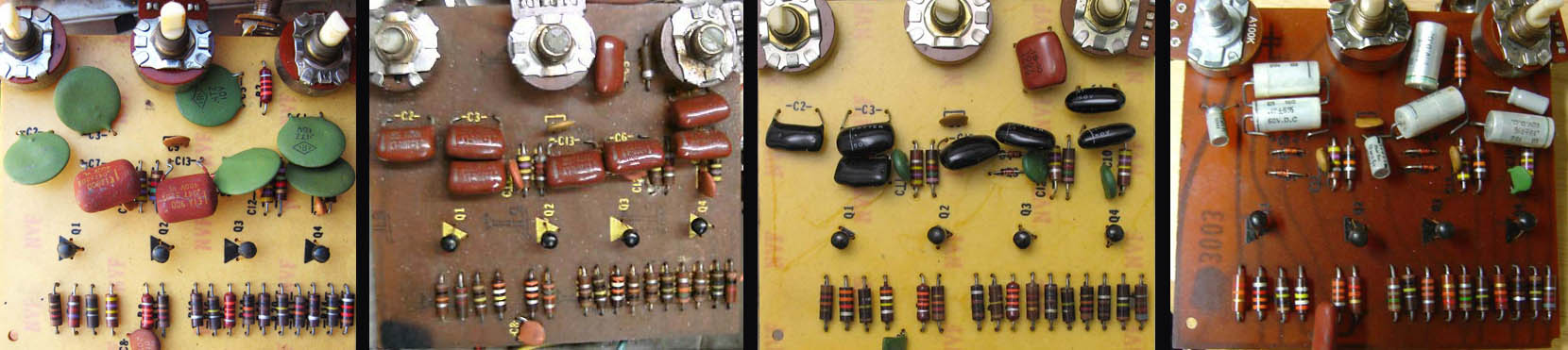
Shown above - selection of 1973-74 Big Muff circuits showing the wide variety of component types and values used, making them sound different from one another.
Suffice it to say, those 1970s Big Muffs came in a very wide variety of sounds. Although all had a distinct character that identified them as Big Muffs, the sound of those variants ranged from clear or muddy, fuzzy or crunchy, high gain or low gain, deeply scooped or moderately scooped mid range, chunky bottom end, or fat, thundery lows. Out of the many Ram's Head Big Muffs I have played, the few that really stand out among the others to me, and that sound exceptionally Gilmourish, are the ones with the Violet Big Muff circuit, manufactured around 1973-1975. This was a very common circuit variant from that period, with the typical huge, dark V2 sound, crunch, and grit, but it also had a clarity unlike many typical Ram's Heads and a tight low end. The Electro-Harmonix Ram's Head Big Muff reissue from 2019 was based on this circuit. A vintage 1973 violet from my collection was dissected and measured by EHX. That involved carefully de soldering and removing the capacitors, resistors, and transistors from the circuit board and measuring the electrical values. Many of the components ended up measuring very differently from the printed values. The resulting replica sounded nearly identical to my original, and I highly recommend it for Gilmour tones.
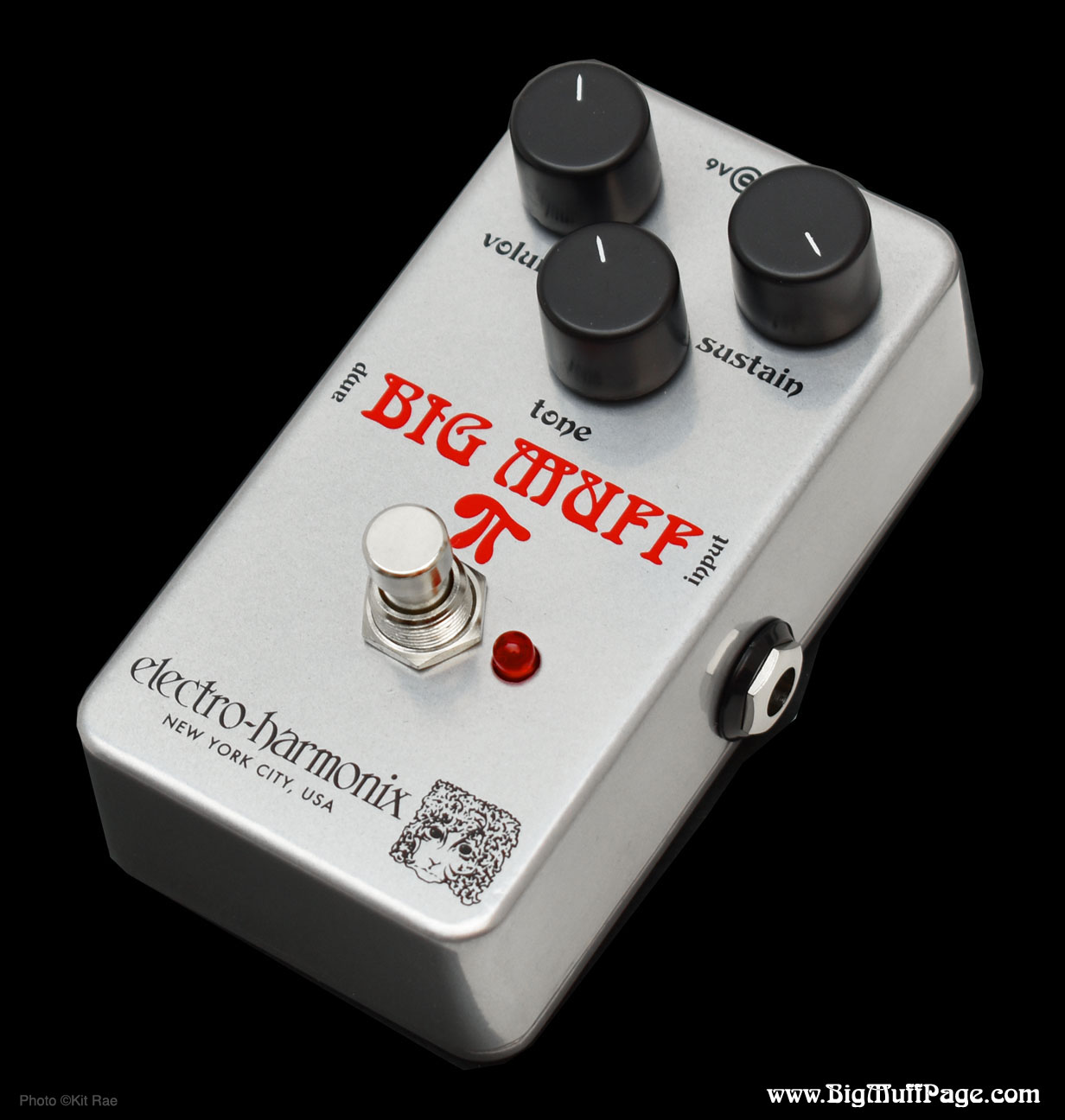
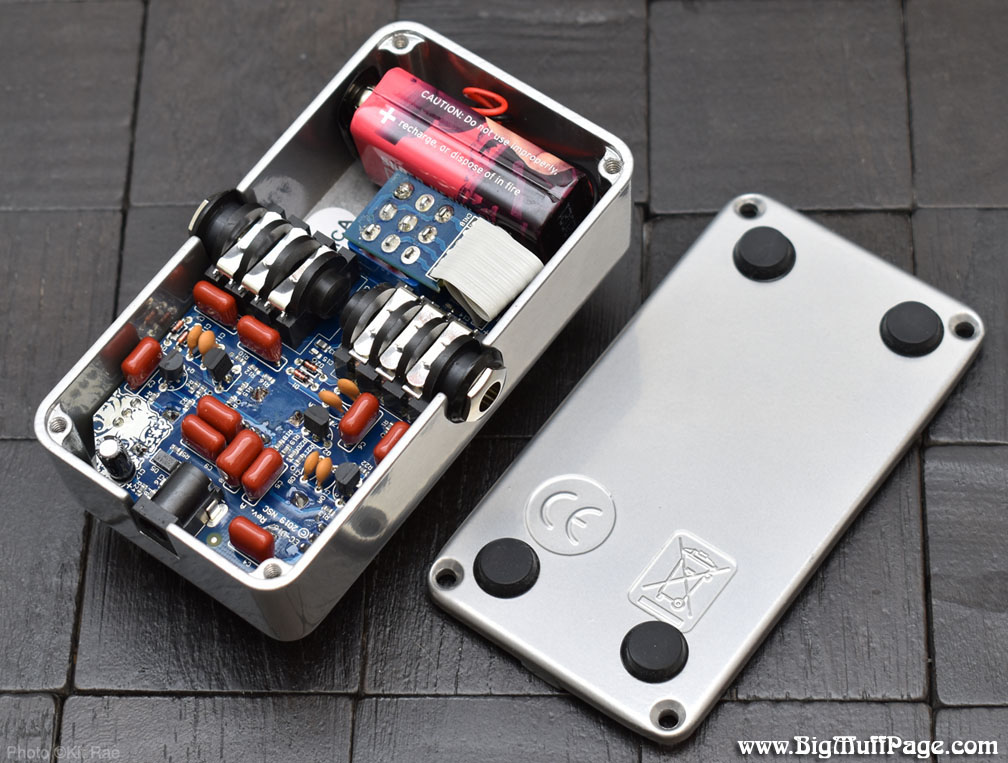
The EHX Ram's Head Big Muff (2019) is a faithful reissue of a 1973 "violet" Ram's Head circuit,
which is likely similar to the circuit in David Gilmour's original Ram's Head
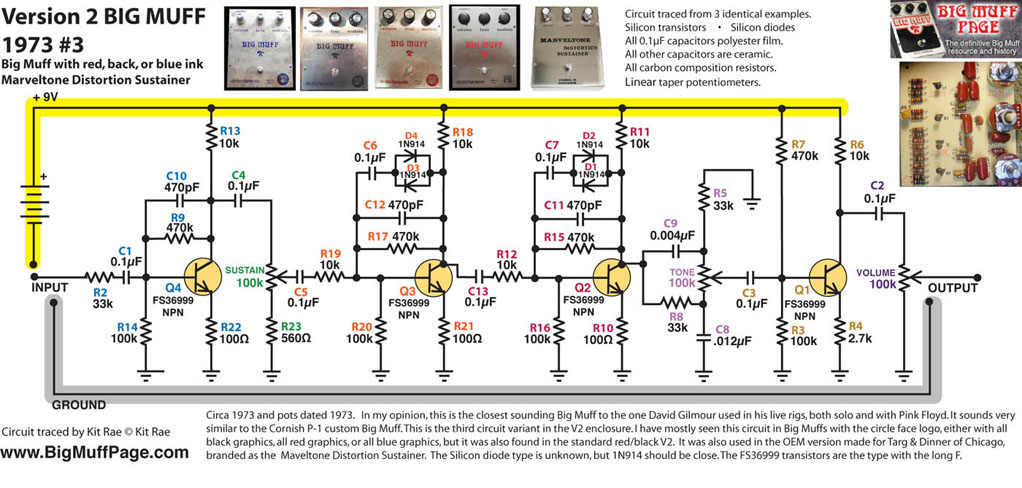
Another Big Muff circuit variant from the 1973 period, one I simply call the '73 Ram's Head or the Brick Muff, also reminds me of some of the more aggressive Big Muff+Colorsound Power Booster tones I hear on the Animals tour and The Wall. However, the most accurate sounding 1973 variant I have played is an earlier one (schematic shown below) that sounds the closest in my rig to Gilmour's The Wall and The Final Cut tones. I have seen this exact circuit in the standard Ram's Head enclosure, as well as the circle face (all red color, all black, or all blue) logo version. It was also used in the Marveltone Distortion Sustainer, an OEM version of the V2 Big Muff made by EHX for Targ & Dinner in the mid 1970s. I have owned several of them, and each sounded relatively the same. The primary difference between this variant and the "violet" circuit variant is that all of the collector resistors and the limiting resistors are 10k. Nearly all the other values are identical to the violet circuit. It did appear in some Big Muffs with the violet or blue ink, so technically it can be called a "violet". It also sounds very close to the Pete Cornish P-1, a clone of a mid 1970s era Big Muff with a buffer added.
Even if you knew the exact circuit variant used in David's original, going by the printed component values alone will not get you an exact copy of that sound. Many of the critical components from 1973 were often out of the specified tolerance to begin with, and as the parts aged over the years, those values changed even more. For example, nearly all the 470k resistors in my unit actually measure closer to 540-550k, and the 470pF capacitors measure closer to 560pF. Many of the small value resistors measure 1-2k higher than the printed value, et cetera. All those differences are enough to alter the sound compared to the sound of a replica made using the schematic values alone. Without measuring each component in David's DG ORIGINAL Big Muff, it is just a guessing game.
Thanks to - Mike/Analogman, for relaying his conversation with Phil Taylor in 2006. Pete Cornish, for answering my many annoying questions! Bjørn Riis, for additional info and our many emails on this subject. Phil Taylor, for intruducing David to the Big Muff, eventually resulting in Comfortably Numb, which sparked my love of Pink Floyd, my addiction to everything Big Muff, without which the Big Muff Page and this website would never exist.
CONTINUE - TO PAGE 2 OF THE GILMOUR BIG MUFFS
HISTORY OF THE BIG MUFF PART 2 (Russian)
HISTORY OF THE BIG MUFF PART 3 (modern USA)
© Kit Rae. This page is not authorized, affiliated, or associated with Electro Harmonix in any way
Website and contents ©2007, ©2010, ©2023 Kit Rae. All rights reserved. Linking to this website is allowed, but copying the text content is strictly prohibited without prior authorization. No part of this work may be reproduced, stored in a retrieval system, or transmitted in any other form, or by any means, electronic, mechanical, photocopying, recording, computer networking, or otherwise without prior permission in writing from the copyright holder(s).
Kit’s Secret Guitar, Gear, and Music Page
Guitar stuff, gear stuff, soundclips, videos, Gilmour/Pink Floyd stuff, photos and other goodies.
Contact: [email protected]
Copyright Kit Rae.












VISIT MY SWORDS, KNIVES and FANTASY ART WEBSITE www.kitrae.net
LEGAL STUFF
Kit’s Secret Guitar, Gear, and Music Page and the Big Muff Page are a personal fan site. Information and materials from this website are intended for personal use only and may not be linked to via the internet/world wide web, republished, reproduced, re-written, reprinted, rebroadcast, disseminated, and/or duplicated in whole or in part, for commercial or any other purposes whatsoever and is strictly prohibited without prior WRITTEN consent from the publisher at www.kitrae.net.
This is a personal fan site and is not affiliated in any way with Electro-Harmonix, Pink Floyd, any of its past or present members, their record label(s), or Pink Floyd Music Ltd. This is not an official Pink Floyd or Electro-Hrmonix website. Please see http://www.pinkfloyd.co.uk for Pink Floyd's official website. "Pink Floyd" images and music are licenced under the trademark of Pink Floyd Music, Ltd. Please see http://www.ehx.com for the official Electro-Harmonix website.
Links To Third Party Sites:
Kit’s Secret Guitar, Gear, and Music Page, and The Big Muff Page (“www.kitrae.net/music/music.html”) may contain images of and links to third party Web sites ("Linked Sites"). The Linked Sites are not under the control of “www.kitrae.net/music/music.html” and “www.kitrae.net/music/music.html” is not responsible for the contents of any Linked Site, including without limitation any link contained in a Linked Site, or any changes or updates to a Linked Site. “www.kitrae.net/music/music.html” is not responsible for any other form of transmission received from any Linked Site nor is “www.kitrae.net/music/music.html” responsible if the Linked Site is not working appropriately. “www.kitrae.net/music/music.html” is providing these links only as a convenience, and the inclusion of any link does not imply endorsement by “www.kitrae.net/music/music.html” of the site or any association with its operators. You are responsible for viewing and abiding by the privacy statements and terms of use posted at the Linked Sites.